
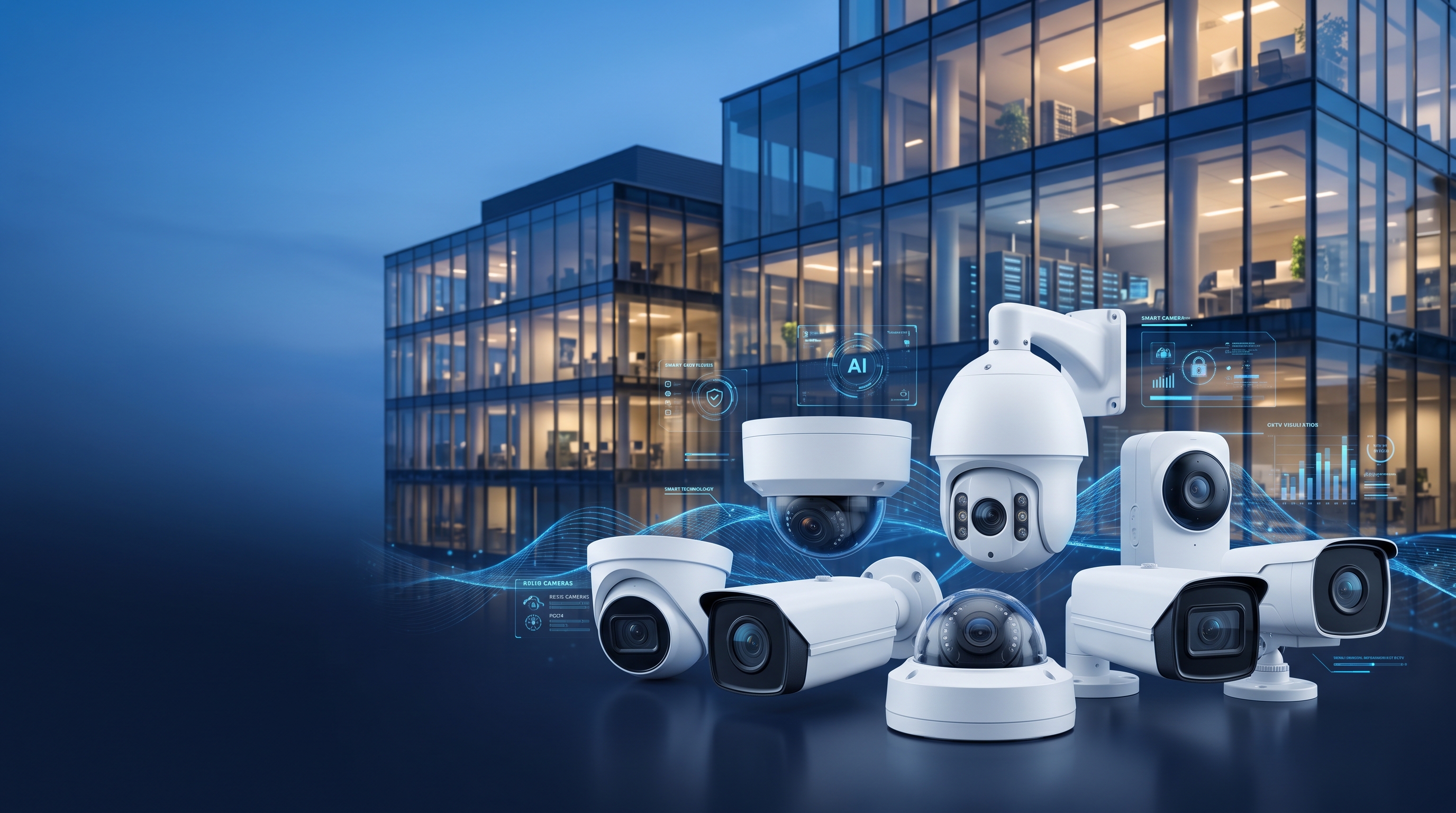
Not all CCTV cameras are interchangeable. A camera that's perfect for monitoring a reception desk can be the wrong choice for a parking lot, and vice versa. Here's a straightforward breakdown of the main camera types and where each one actually makes sense.
Dome cameras — general indoor coverage
Dome cameras have a compact, ceiling-mounted design with a tinted cover that makes it hard to tell exactly which direction the lens is pointing. They're a good default for indoor spaces like offices, retail floors, and hallways — discreet, vandal-resistant in most models, and easy to mount flush against a ceiling.
Bullet cameras — visible outdoor deterrence
Bullet cameras are the cylindrical, wall-mounted cameras most people picture when they think of CCTV. Their long, narrow shape is built for long-range viewing in one fixed direction, which makes them a strong choice for covering a specific outdoor area like a gate, driveway or perimeter fence. Their visibility is often a deliberate feature — a clearly visible camera can itself discourage intrusion.
Turret cameras — a flexible middle ground
Turret cameras sit between dome and bullet designs: a ball-and-socket mount lets you angle the camera precisely without the dome's curved cover, which can sometimes cause glare at night. They work well both indoors and under a covered outdoor area, and are increasingly common for entrances and building exteriors.
PTZ cameras — active monitoring of large areas
Pan-tilt-zoom (PTZ) cameras can be remotely rotated and zoomed, either manually by a security operator or automatically via motion tracking. They're the right choice for large open areas — warehouses, large parking lots, large retail floors — where a single fixed camera can't cover the whole space, but they cost more and are typically used alongside fixed cameras rather than replacing them entirely.
A simple way to decide
- Reception, hallways, retail floor → dome camera
- Gate, driveway, perimeter fence → bullet camera
- Entrance, building exterior, covered outdoor area → turret camera
- Large warehouse or lot needing active coverage → PTZ camera, usually alongside fixed cameras
Do I need night vision on every camera?
Any camera covering an area that's unlit or poorly lit at night should have infrared or low-light capability — otherwise footage from that camera becomes close to useless after dark.
How many cameras does a small office actually need?
It depends on the layout, but most small offices are well covered with cameras at the main entrance, reception, and any secondary exits — the goal is covering access points and blind spots, not blanketing every square foot.
We stock CCTV cameras and NVR kits from Hikvision and Dahua, and our technical team offers on-site installation and configuration for homes and businesses of any size. Browse our CCTV systems, or if you're planning a multi-camera setup for a business or facility, our business team can put together a proper site-appropriate quotation.